_edited.png)
Understanding Overtime in Hungary: 2026 Overview (Labor Law, Mt könyve) – Part 1
- Apr 4
- 3 min read
Overtime is one of the most discussed aspects of employment law in Hungary, as it directly affects both employee well-being and business efficiency. In 2026, the Hungarian Labor Code (Act I of 2012, with its latest amendments: Mt könyve) continues to provide a detailed framework for how overtime should be managed, compensated, and recorded. For employees, understanding these rules ensures fair treatment and proper pay. For employers, compliance helps maintain trust, avoid penalties, and promote a healthy workplace culture.
You can read the Hungarian Labor Law for 2026 here: Mt. 2012. évi I. törvény |
What Counts as Overtime
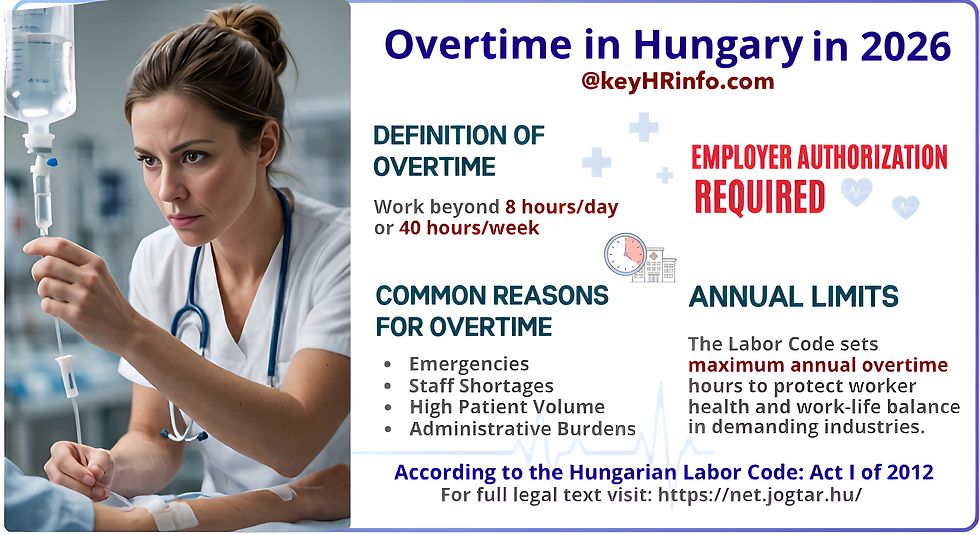
In Hungary, overtime refers to any work performed beyond the employee’s regular working hours as defined in their employment contract. The standard full-time schedule is 8 hours per day and 40 hours per week. Any work that exceeds these limits qualifies as overtime, provided it is ordered or approved by the employer.

Overtime is not simply about staying late at work—it must be formally recognized by the employer. This distinction protects employees from being overworked without proper compensation and ensures that all extra hours are legally documented.
Common Reasons for Overtime
Unexpected workload surges | When projects or client demands increase suddenly. |
Temporary staff shortages | Covering for absent colleagues or unfilled positions. |
Urgent business needs | Meeting deadlines or responding to emergencies. |
Employers must always ensure that overtime is justified, limited, and properly compensated.

Special Rules for Certain Sectors
The Hungarian Labor Code recognizes that not all industries can operate within the same rigid framework of working hours and overtime limits.
Certain sectors—such as healthcare, transportation, energy, and public safety—require continuous or shift-based operations to maintain essential services. For these fields, the law allows flexible scheduling systems and extended reference periods, meaning that working hours and rest periods can be averaged over several weeks or months rather than calculated daily.
However, even under these special rules, employers must strictly adhere to maximum working time limits, mandatory rest periods, and health and safety standards.
Overtime Limits in 2026
Hungarian law sets clear boundaries to prevent excessive overtime. These limits are designed to protect employees’ health and ensure a sustainable work-life balance.
General annual limit | 250 hours per year |
With a collective agreement | up to 300 hours per year |
With an individual agreement | up to 400 hours per year (the “overtime banking” system) |
Weekly limit | The total working time, including overtime, cannot exceed 48 hours per week. |
These limits are not just administrative—they reflect Hungary’s commitment to aligning with European Union labor standards. Employers must also maintain accurate records of all overtime hours, which can be reviewed by labor authorities during inspections.
Why Overtime Regulation Matters
Overtime laws are not only about pay—they are about protecting human capacity. Excessive working hours can lead to fatigue, reduced productivity, and health issues. By setting clear limits, the Hungarian Labor Code ensures that employees can rest, recover, and perform effectively.
Employers who respect these boundaries often see higher morale, lower turnover, and stronger organizational loyalty. In contrast, ignoring overtime rules can lead to fines, legal disputes, and reputational harm.
Frequently Asked Questions (FAQ) About Overtime in Hungary: 2026 Overview (Labor Law, Mt könyve)
What is considered overtime under Hungarian labor law?
Overtime is any work performed beyond the standard eight hours per day or forty hours per week, provided it is ordered or approved by the employer.
How many overtime hours can an employee work per year?
The general limit is 250 hours per year, which can increase to 300 hours with a collective agreement or up to 400 hours with an individual agreement.
How is overtime compensated?
Employees receive at least a 50% pay supplement for overtime on regular days and 100% for work on rest days or public holidays, or equivalent time off.
Can employees refuse overtime?
Yes. Employees may refuse overtime that exceeds legal limits or is not properly authorized by the employer.
Are there special overtime rules for certain sectors?
Yes. Sectors like healthcare, transportation, and energy may use flexible schedules and extended reference periods to ensure continuous operations.
keyHRinfo.com offers services in areas of payroll implementation, payroll data migration, payroll consolidated reports and analytics to international companies with presence in Hungary.
Overtime in Hungary: 2026 Overview (Labor Law, Mt könyve)


