_edited.png)
Posted Workers and A1 Certificates in 2026: The Practical Employer Compliance Checklist for EU Cross-Border Assignments
The A1 certificate remains one of the most important documents in European labour mobility because it determines which country's social security system applies during a temporary posting. Employers that fail to obtain appropriate documentation risk fines, social security disputes, payroll complications and labour-inspection challenges.
Why Posted Worker Compliance Matters More in 2026
Cross-border employee mobility remains essential for many European businesses, particularly in construction, manufacturing, engineering, consulting, technology and professional services. However, increased enforcement activity and digital compliance initiatives mean that employers must carefully manage posted worker obligations before employees begin work in another EU Member State.

What Is a Posted Worker?
A posted worker is an employee temporarily sent by an employer to provide services in another EU Member State while remaining employed by the sending company. EU rules protect posted workers while ensuring fair competition between businesses operating across borders.
Unlike permanent relocation, a posting is linked to a temporary assignment and the employee is expected to return to the country from which they were posted after completing the work.
Employer Checklist for Posted Workers
Confirm whether the assignment qualifies as a posting or a business trip.
Obtain an A1 certificate before the assignment begins.
Verify host-country posted worker notification requirements.
Review remuneration and employment conditions applicable in the host country.
Check working time, leave, health and safety and accommodation obligations.
Maintain assignment documentation and employment records.
Coordinate HR, payroll, tax and legal teams before deployment.
Monitor assignment duration and long-term posting thresholds.
Prepare for labour inspections and document requests.
Review social security and mobility processes regularly.
Posted Worker Compliance Responsibilities
Compliance Area | Employer Responsibility | Risk if Ignored |
A1 Certificate | Apply for and maintain valid social security documentation | Social security disputes and penalties |
Posting Notifications | File required declarations in host countries | Administrative fines |
Pay and Benefits | Meet applicable remuneration requirements | Employment law violations |
Working Conditions | Apply relevant labour standards | Worker claims and inspections |
Documentation | Retain records and assignment evidence | Compliance failures during audits |
The Importance of the A1 Certificate
The A1 certificate confirms that a worker remains covered by the social security system of the sending country while working temporarily in another participating state. Without an A1 certificate, the default assumption is generally that social security contributions may become due in the country where the work is performed.
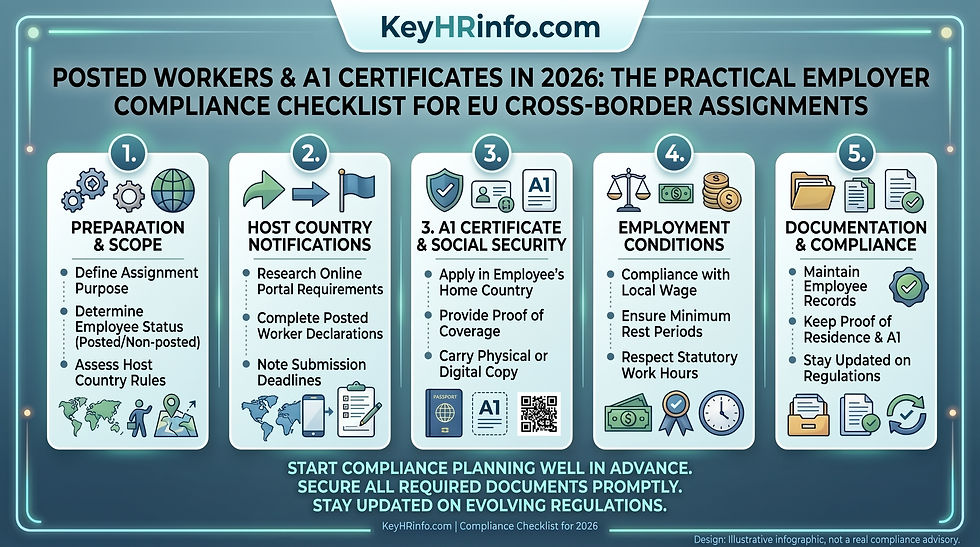
In practice, the A1 certificate supports legal certainty for employers and employees by avoiding duplicate social security obligations and establishing which national system remains applicable during the assignment.
Practical A1 Certificate Control Framework
Control Step | HR Action | Recommended Timing |
Assignment Review | Confirm posting eligibility | Before assignment approval |
Social Security Assessment | Determine applicable coverage | During planning stage |
A1 Application | Submit application to competent authority | Before travel begins |
Host-Country Review | Check notification and labour requirements | Before deployment |
Ongoing Monitoring | Track assignment duration and changes | Throughout posting |
Key Employment Conditions Employers Must Review
EU posted worker rules require employers to consider host-country employment protections where applicable. These can include:
Remuneration requirements
Maximum working hours
Minimum rest periods
Annual leave requirements
Health and safety standards
Non-discrimination protections
Accommodation standards when provided by the employer
Travel, board and lodging reimbursement rules
These protections are designed to create a level playing field and protect workers during temporary cross-border assignments.
Posted worker compliance is no longer simply an HR administrative task. In 2026, it sits at the intersection of labour law, social security, payroll, tax compliance and workforce mobility strategy, requiring close coordination between multiple business functions.
The most successful employers treat A1 certificates and posted worker obligations as part of a structured mobility governance programme rather than a last-minute paperwork exercise. Early planning, clear documentation and effective cross-functional cooperation remain the best safeguards against compliance risks, assignment delays and unexpected costs.
Frequently Asked Questions (FAQ) about Posted Workers and A1 Certificates in 2026
What is an A1 certificate?
An A1 certificate confirms which country's social security legislation applies during a temporary cross-border assignment.
Does every posted worker need an A1 certificate?
In most cross-border posting situations, employers should assess A1 certificate requirements before work begins.
Is a business trip always a posting?
No, ordinary meetings, conferences and training activities may be treated differently from service-provision postings.
Can posted worker rules apply to short assignments?
Yes, compliance obligations may apply even for relatively short cross-border assignments.
Why is documentation so important?
Documentation helps demonstrate compliance during labour inspections and social security reviews.


