_edited.png)
Employee Pay Data and GDPR: Balancing Transparency with Data Protection in 2026
Pay transparency and privacy are not opposing goals: both seek accountable, fair and trustworthy use of workforce information. The strongest 2026 programmes will disclose enough to make pay systems understandable and challengeable while protecting employees from avoidable identification, misuse and security risk.
Why Pay Transparency and Data Protection Must Be Designed Together
In 2026, the EU Pay Transparency Directive is changing how employers communicate salary ranges, explain pay-setting criteria and respond to worker requests for comparative pay information. At the same time, salary, bonus and benefit records remain personal data, so every disclosure must comply with GDPR principles including lawfulness, fairness, transparency, purpose limitation, data minimisation, accuracy, storage limitation and security.
The key distinction is between transparency about pay systems and unnecessary exposure of identifiable individual salaries. Employers can usually meet equal-pay objectives by using well-defined worker categories, aggregated or gender-disaggregated averages, controlled access and clear explanations rather than publishing named payroll records.
What Changes in 2026?
Requirement | Transparency objective | GDPR control |
Recruitment pay information | Provide the initial pay level or range before employment and avoid asking applicants about pay history. | Use role-based ranges and collect only information necessary for recruitment. |
Worker information requests | Provide individual pay and average pay levels by sex for comparable work categories. | Prevent identification of colleagues in very small groups and disclose through authenticated channels. |
Pay-setting criteria | Make criteria for pay, pay levels and progression accessible, objective and gender-neutral. | Explain the process without exposing unrelated performance or personal information. |
Gender pay gap reporting | Report required metrics for employers within applicable workforce thresholds. | Validate datasets, limit internal access and publish only the required outputs. |
Joint pay assessment | Investigate an unjustified gap of at least 5% when the Directive’s conditions are met. | Use pseudonymised working files and controlled sharing with worker representatives. |
Seven Practical Controls for HR, Payroll and Legal Teams
· Map every pay-data use: document recruitment, payroll, analytics, reporting, employee requests and representative access.
· Confirm the lawful basis: distinguish processing required by law from contractual necessity or a carefully assessed legitimate interest.
· Define worker categories: use objective criteria such as skills, effort, responsibility and working conditions, and test whether small groups expose individuals.
· Minimise data: separate identifiers from analytical files and exclude fields not needed for the stated purpose.
· Restrict and log access: apply role-based permissions, periodic reviews, secure transfer and audit trails.
· Set retention rules: keep raw and derived pay datasets only as long as legal, reporting and dispute needs justify.
· Prepare communications: update privacy notices, request procedures and manager guidance so employees understand both the disclosure and its limits.

A GDPR-Safe Pay Transparency Workflow
Pay transparency does not create a general right to inspect every colleague’s salary file. The Directive focuses on structured rights and reporting, while GDPR requires employers to choose the least intrusive disclosure that still fulfils the legal objective.
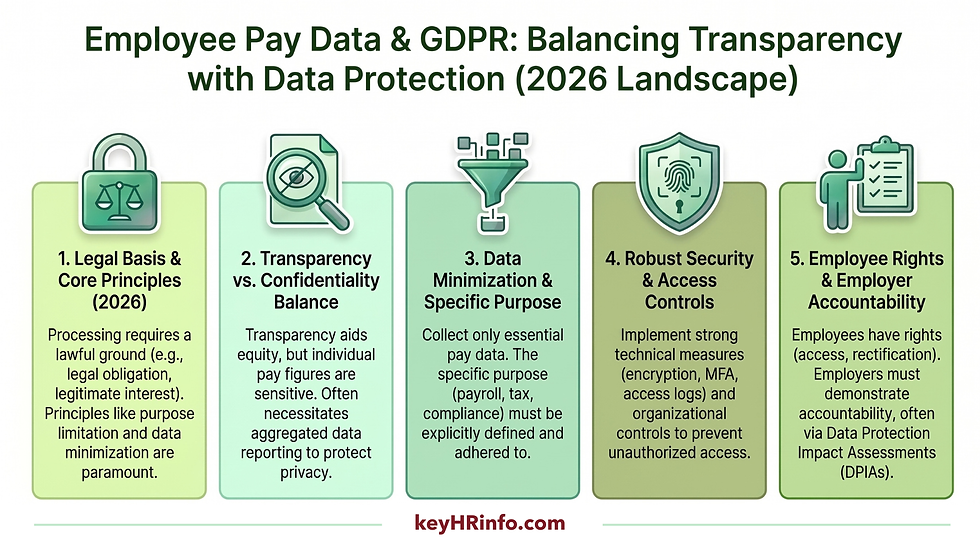
A privacy-aware workflow begins with an accurate job architecture and ends with a secure, intelligible response. It should include documented calculations, suppression or aggregation rules for small groups, quality checks and a review path involving HR, payroll, legal and the data protection officer where appropriate.
Workflow stage | Recommended action | Risk reduced |
1. Scope | Identify the legal obligation, affected employees, jurisdiction and deadline. | Purpose creep and unnecessary processing |
2. Prepare | Extract only required pay elements and verify accuracy against payroll and HR systems. | Incorrect or misleading disclosure |
3. Categorise | Group equal or equal-value work using objective, documented criteria. | Inconsistent comparisons and discrimination risk |
4. Protect | Pseudonymise working files, restrict access and apply small-group safeguards. | Re-identification and unauthorised access |
5. Explain | Provide required figures with methodology, context and routes for questions or correction. | Confusion, mistrust and disputes |
6. Retain and review | Archive evidence according to policy, delete surplus files and review outcomes. | Excessive retention and repeated control failures |
Employers should move beyond one-off reporting and build a repeatable governance model in which every pay-data disclosure has a clear purpose, accurate source, appropriate legal basis, limited audience and documented retention period. Done well, this approach supports equal pay, satisfies employee rights and strengthens confidence that highly sensitive workforce information is handled responsibly.
Frequently Asked Questions (FAQ) about Employee Pay Data and GDPR in 2026
Is an employee’s salary personal data under the GDPR?
Yes, salary and related compensation information concern an identifiable person and are therefore personal data.
Does pay transparency require employers to publish named salaries?
No, the EU framework generally relies on ranges, individual access rights, comparative averages and reporting metrics rather than universal publication of named salaries.
Can employers rely on employee consent for pay reporting?
Consent is often unsuitable in employment because of the power imbalance, so employers should identify the legal basis that genuinely matches each processing purpose.
How should very small comparison groups be handled?
Employers should assess re-identification risk and use aggregation, suppression or controlled access while still meeting applicable legal rights.
What should employers prioritise in 2026?
They should align job architecture, payroll data, privacy notices, access controls, retention rules and response procedures before transparency requests and reporting deadlines intensify.
keyHRinfo.com offers services in areas of payroll implementation, payroll data migration, payroll consolidated reports and analytics to international companies with presence in Hungary.
Employee Pay Data and GDPR in 2026


